
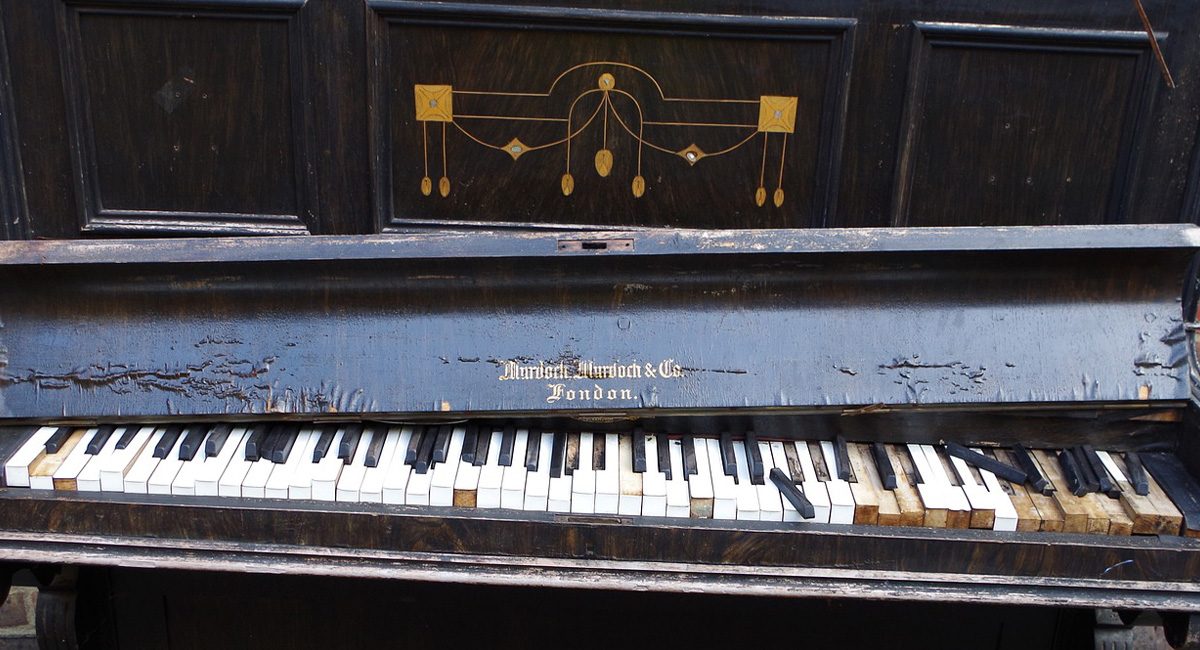
A good piano teacher will often help with the cultivation of healthy practise habits. They will advise on tactics and techniques you can use in your practise sessions to make them as useful and efficient as possible, but what are some of the most common mistakes pianists make in their practise?
By learning what not to do, hopefully you can avoid these pitfalls yourself and see instant improvement to the quality of your practise and the rate that you learn pieces!
- Not Warming Up
So you’ve sat down behind the piano to practise – what do you do first? Too many people dive straight in to their pieces without warming up. Personally I recommend my students to do 1 of 2 things. The first is to warm up on scales and arpeggios. First slowly with a focus on technique and then working in to a faster tempo.
Secondly, do the thing you want to do the least first. For a lot of people the aspect of playing piano that they dislike the most is the dreaded sight reading! However, sight reading (playing a short, “easy” piece of music with a very short period to study it beforehand) is one of the most beneficial aspects of playing any instrument. It increases several skills including your body’s feel for the “geography” of the piano, your note reading ability, rhythmic awareness and puts a lot of the theoretical ideas we study in to practise.
After warming up correctly you will find that the rest of your practise session is more productive and relaxed. Personally, if I’m hunkering down for a long practise session or practising something that is pushing the limits of my technique I will also add in some light banded resistance exercises to get some blood pumping to my wrist and to increase mobility. Having some water or coffee to hand is always useful also!
- Incorrect Seating Position
Seating position is absolutely key to good piano technique. We want to have a piano stool that is at such a height that it allows our elbows to form a right angle between the bicep and forearm when fingertips are on the keys, shoulders loose and our chest is up without being sat stiff upright. The elbows should also be in line with the torso so not in front or behind your body.
Feet should be flat on the floor except when using the pedals in which case the heels should stay in contact with the floor at all times and our centre of gravity should be on our bum.
And for heaven’s sake don’t use a wheely desk chair! It can be tempting because these are often height adjustable but the wheels do not let you be in a stable seated position that we need when playing piano.
- Not Having A Pencil Within Reach
Sometimes people think that making pencil markings on their sheet music is cheating or something for the teacher to do. Here’s a secret: it’s not!
Always practise with a pencil (mechanical pencils with a rubber on the end are best) on the sides of your piano. This will allow you to quickly write in any finger numbers or note names that are deceiving you.
The only caveat is that we want to avoid the score becoming too crowded, so if you’re writing on every single note name or finger number then this is an indicator that the piece might be too difficult for you, you need to work on your reading comprehension or you need to slow down (more on that later!).
- Going Back To The Beginning
Imagine that you have been tasked with learning the lines of an epic poem for a recital in front of a live audience. You have to memorise every single word, how they are pronounced and ultimately perform the poem with emotion and meaning.
How would you go about the memorisation of this work? There are a number of different methods but you almost definitely would not attempt to memorise the entire poem in one go. You would break the poem down in to paragraphs and sentences maybe working on memorising a paragraph a day and then checking that you could still remember that paragraph the next day.
One of the most ineffective ways of memorising the poem would be to start at the beginning, read it to the end and then go back to the beginning to repeat the whole process again. By the time you’d got to the second paragraph you would have probably forgotten most of what was contained within the first paragraph. You might be able to remember the meaning of the paragraph but the exact words and the order in which they came would be quite inaccurate.
The situation is exactly the same when learning a piece of piano music. If a pianist is confronted with a piece of 68 bars of notation then they will break it down in to chunks. Looping and repeating the same phrases over and over again whilst trying to perfect all the details contained within that phrase is a much better approach. If there is a tricky section of that phrase, perhaps a large leap of the hands, then it is best to “zoom in” on that single part and loop it until it becomes easy. This is how we practise.
The most ineffective form of practise is to start from the beginning of a piece, struggle through to the end (whilst ignoring any mistakes) and then go back to the beginning again. It is not until much later in the learning process, when each section is already in our muscle memory, that we practise these types of run throughs.
The mind does not process large amounts of information very efficiently and so by going back to the beginning every time it is often demoralising to the learner as they feel they are putting in lots of work for very little progress. The moral of “work smarter, not harder” is true here.
Be modest in your expectations from each practise session. Aim to polish a few bars or a line or two, not the entire piece. With consistent practise, you’ll be surprised at how quickly those individual lines lead to a completed piece!
- Not Repeating
Leading on from the last point, once the small sections of your piece have been defined and played through once, don’t be satisfied then! In music we don’t play a passage until we get it right, we play it until we can not get it wrong!
Flea, the bassist from The Red Hot Chili Peppers, is known to be one of the most fervent practisers in all of rock music. He aims to play each section of every song 19 times in a row perfectly before he moves on to the next section. If he makes a mistake on the 18th time then his count goes back to 1 and he continues aiming for 19 times again.
As mentioned, it is not just repetition but good repetition that yields the best results. Having your attention to all the dynamics, articulation, rhythm, fingering and technique is essential when repeating sections so you are not just practising like a robot. However, repetition is key to memorising pieces and to build speed. Personally, I like to aim to play each phrase perfectly 5 times in a row before moving on. The next time I sit behind the piano I will then head straight to that section after warming up to see if more practise is required.
- Not Breathing
This might seem like a silly one but it’s something I see all the time! As we’ll talk about later, there’s a lot of things to think about at once when playing piano and this can lead to us getting stressed whilst playing. When this happens a lot of people’s instinct is to stop breathing because they’re concentrating so hard!
This is one of the worst things we can do when trying to learn because we are slowly starving the brain of oxygen and thus impairing its capacity to process information. The negative feedback loop looks a little like this.
- We get stressed so we stop breathing
- Our brain starts depleting of oxygen and its ability to process information is impaired.
- Because of this impairment we struggle to process the information even more.
- We get more stressed because we carry on making mistakes.
Holding our breath is often accompanied by other signs of tension in our body such as raised shoulders, a tight wrist, clenching our jaw and leaning forward on the stool. All of these factors make it harder for us to play and yield an unpleasant sound from the piano. Bringing awareness to these signs of tension is a key part of playing any instrument and ultimately leads to greater relaxation and enjoyment of what we’re doing.
- Doing Too Much At Once
Sometimes reminding ourselves to breathe just isn’t enough. Sometimes the task at hand is just too hard. What do we do then?
A good teacher will never assign a piece that a student is not ready to learn so we have to remind ourselves that we can do this but maybe we need to change our approach! Piano sheet music contains many different instructions and components including:
- Notes for right hand and left hand.
- What speed to play at.
- The timing of the notes.
- How loud or quiet we should play.
- Whether to play smoothly or bouncily.
- To use pedal or not.
To do all of these things at once can be a real challenge especially in the early stages of the piece and often people fail to do this. So when learning a piece the answer is often simpler than people think. Don’t!
If you are struggling with a section of a piece then ask yourself what you are specifically struggling with. Is it the correct notes? Is it the rhythm? Are you fine playing hands separately but struggle putting the hands together?
Let’s say you are struggling with the rhythm. First of all separate the hands so you do right hand only first. Take away the element of changing notes, and slowly try and tap out the rhythm of the right hand passage on a single note. Repeat this until comfortable. Then try the same thing with the left hand. Slowly, whilst counting, try putting the hands together whilst still playing one note per hand. Repeat until comfortable. It can help to imagine what the melody will sound like in your head whilst doing this also.
Now you have fixed the rhythmic issue! You just need to be able to play the correct notes now.
When learning to juggle we start with one ball, then two, then three and so on. The same thing applies in music. When struggling, identify the multiple elements of the music, ask yourself what you are struggling with and then zoom in on that element. The results you see will blow you away!
- Going Too Fast
This is something I say at least ten times per working day – “slow down”. Playing too fast too early in the learning process inevitably leads to mistakes and often frustration. The correct speed to play at is the speed at which you can play everything correctly. As mentioned, we need to eventually add in all the different elements of music notation to the sections of our piece and in order to do that we need to give our brain a fighting chance at processing it all!
The best way to do this is to go slowly. Speed is the last thing we add to a piece and what you’ll find is that, if you’ve been meticulous in your preparation of a piece, it’s actually quite easy to play fast.
Sometimes if a student is learning a piece and they know what it sounds like, they will want to play it at the speed that they know it at. This is almost always too fast. In this scenario, I often encourage my students to imagine the sound of that song being played on a record playing playing at the wrong RPM… or as if the performer of the music has had a bit to drink and is going too slowly!
- Being Harsh On Yourself
Remember that learning the piano takes a long time to get to what a lot of people consider a “competent” standard. It’s a long road and you should ignore anyone who tells you there are any shortcuts. On this road it’s also guaranteed that you will read the directions wrong, take detours and be faster on some days than you are on others.
Too often we expect greatness from ourselves from day one, but this is illogical. You have to be bad at something before you get good at it and reminding yourself of this fact when you make a mistake can be an enormous release from the clutches of perfectionism. What does matter is that you recognise mistakes when they happen. It doesn’t matter if you realise the mistake yourself or if your teacher points it out to you but you should try and be mindful to try and avoid this mistake in the future.
The key word in this last sentence is “try”. You might make the mistake again or maybe four or five times and that’s ok! As long as you recognise it you can get to the root of it and this is all part of the learning process. The best approach is to not lament mistakes by berating yourself. Maybe you have told yourself things like “I will never get this” or “I can’t believe I made this mistake again” but these things do not help. Instead, a cold, objective identification of mistakes without judgement is easier on your motivation levels and leads to more productive practise.
- Keeping Distractions At Bay
Ideally, when practising piano, we want to be in a state of “flow”. This does not mean that the notes are constantly flowing under our fingers but instead that we are constantly concentrating on the task at hand. Are we being mindful of the dynamics whilst playing? Are we breathing freely? Did we check the key signature? Are we using the most efficient fingering possible?
Our daily lives are full of distractions which make it more difficult to achieve this state of flow. Messages from friends, beeping smart phones, children needing attention and daily duties can all get in the way of us sitting behind the piano and doing effective practise.
Try to schedule your practise in to your diary or find a time of day where you know you can put everything else to one side for half an hour or so. If other people in your house are often the distraction then let them know that you are going to do some practise and (in the nicest possible way!) will need to be left alone for a little while. This allows you to really concentrate on the task at hand and means you practise for the amount of time you intended and no less.
And I’m begging you please, don’t put your phone on the music stand!