
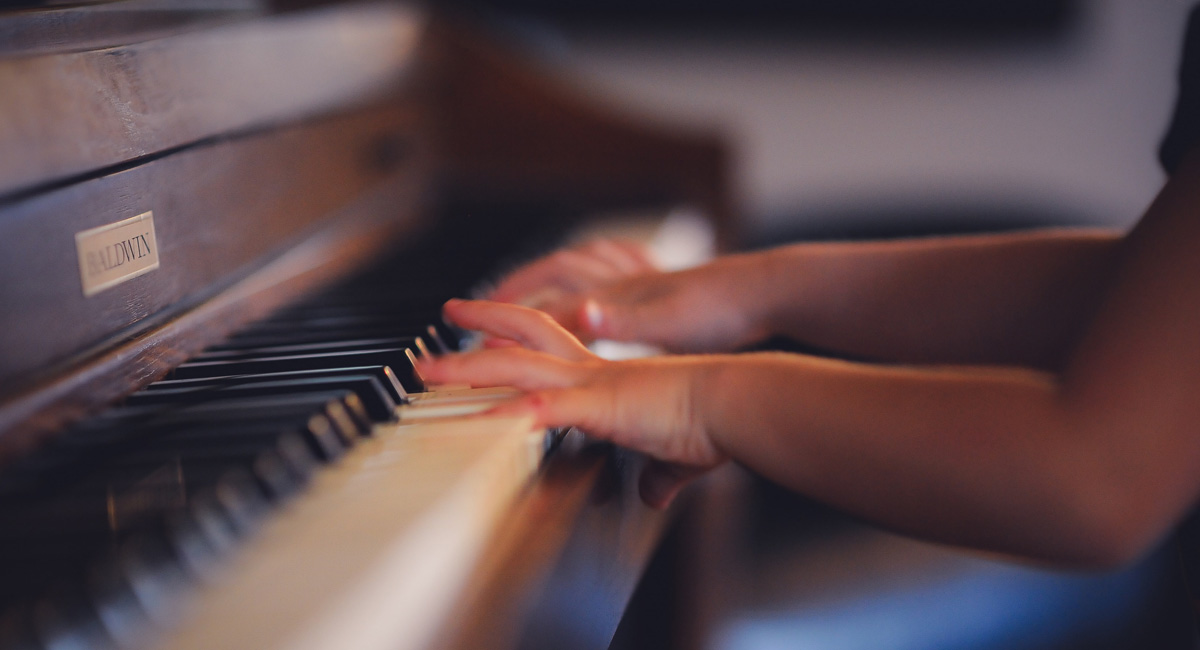
Behind most great pianists there is a great teacher. Getting proper piano lessons can prevent a beginner pianist from wasting time looking for the “right” things to practise, coach good technique and nurture a love of music among other things. Of course, it is possible for a student to learn successfully entirely by their own but not only is this less common, it’s also likely that it would take a student longer to get their playing to a certain standard than it would if they’d worked with a teacher.
So there’s plenty of information about brilliant and famous pianists but what about their teachers? Indeed, some famous performing pianists have dtaught their fair share of lessons however the reality is that a lot of the time they are too busy performing or composing that they don’t have the time to teach! Sometimes you find great performers who aren’t the best teachers as the two skills, whilst related, are quite different. For this reason you might not have heard of a lot of the great piano teachers. See below to see why you should care.
Who? Carl Czerny
What Did They Do?
Czerny (1791 – 1857) was an Austrian composer, teacher and pianist who received lessons from Beethoven himself! Having impressed his teacher behind the piano, he started teaching at the tender age of 15 with his most notable student being one of the most virtuosic pianists of all time, Franz Liszt.
So what?
Many of the modern day and 20th Century greats can trace their “pedagogical lineage” back to Czerny including Daniel Barenboim, Rachmaninoff, Leon Fleisher and Sergei Prokofiev. However, Czerny’s influence is still hugely present in everyday piano lessons with his widely utilised publications of technical exercises and etudes including: “The Art of Finger Dexterity, op.740”, “The School of Velocity, op.299” and “Practical Method for Beginners, op.599”. Whilst these works are not without their critics, they are often praised for both their practical application in playing other classical repertoire whilst still being pleasing to the ear themselves.
Who? Nadia Boulanger
What Did They Do?
Boulanger (1887 – 1979) hailed from a very musical family (she was the sister of Lili Boulanger and daughter of Ernest Boulanger) and showed musical promise from a young age yet chose to shun a career of composing or performing because she believed she wasn’t talented enough. Again, like Czerny, she gave lessons to many famous musicians including Daniel Barenboim, Quincy Jones and Philip Glass.
So what?
At a time when studying piano was still the preserve of the wealthy, Boulanger prided herself on taking on students from all backgrounds doing most of her teaching from her Parisian apartment. As long as you were willing to learn you could have Boulanger as a teacher. She emphasised individual creativity both in her performance and compositional teaching as well as the need to be mindful and present at all times whilst playing. As a teacher Boulanger took a holistic view as she incorporated sight-singing using “fixed-Do” solfège in her teaching methods. She also pushed the boundaries for women on the international stage being the first woman to conduct the BBC Symphony, Hallé and Philadelphia orchestras.
Who? Abby Whiteside
What Did They Do?
Up until Whiteside (1881 – 1956) started teaching the dominant approach to learning pieces was “drilling” the notes and rhythms of a piece in to a player’s fingers and thus in to their muscle memory. Whiteside, however, disagreed with this as a primary approach and instead advocated for a “full body” approach to technique which included arm and torso movements. She even pushed back against the thought that muscle memory is the best way to learn a piece instead teaching that pieces should be learned as an “intrinsic memory of musical content”.
So what?
As a teacher, Whiteside is hugely important because it has now been recognised that movement in the arm and body is key to avoiding Repetitive Strain Injury when playing the piano for many years. Her method of skipping some notes when practising in favour of prioritising movements is also a very powerful practise tool.
Who? Dorothy Taubman
What Did They Do?
Taubman (1917 – 2013) directed the Taubman Institute of Piano in America. She was a teacher who developed the “Taubman Approach” to piano technique and helped rehabilitate injured pianists such as Leon Fleisher. Her teachings have even been adapted to healthy typing technique!
So what?
Whilst Taubman never wrote down her method she is survived by many of her students who now propagate her teachings. Her technique is based on efficiency, ease of movement and a constant self-assessment of how one moves when playing the piano; all of these elements are lessons we can apply to our own practise!
Who? Dame Fanny Waterman
What Did They Do?
Born in Leeds, Waterman (1920 – 2020) was a teacher who was passionate about making sure that music lessons were taught properly in schools and set up the Leeds International Piano competition. She even gave lessons to prime ministers Edward Heath and John Major!
So what?
During a period when music was not being treated as a priority in the UK education system, Waterman fought to raise awareness of the importance of not just the piano but music lessons in general. The Leeds International Piano Competition became the framework for modern piano competitions. Today her legacy is a swathe of ex-students who are now professional concert pianists and the “Me and My Piano” series of tutor books which are among the most popular piano lesson books in the world.